


OWNERSHIP: 100%
SIZE: 1,756 acres
LOCATION: 22 miles S-SW of Gunnison, CO
Project Overview
100% ownership (royalty-free) interest in 85 mineral claims totalling 1,756 acres (711 hectares) located within the Iron Hills / Powderhorn carbonatite complex, 22 miles S-SW of Gunnison, Colorado
- Prospectivity: The Iron Hill (Powderhorn) carbonatite complex represents one of the world's premier examples of carbonatite-alkaline igneous systems and hosts one of the largest known titanium and REE deposits in the United States. The project, consisting of two non-contiguous claim blocks are situated southeast and west of this historic deposit offer significant exploration potential for multiple critical and strategic minerals based on geological continuity, structural controls, and the documented radial distribution of mineralized carbonatite dikes.
- Initial Exploration Results: 48 rock samples collected during the staking program, with 12 samples returning over-limit results (>1,000 ppm) for TREO. Over-limit samples submitted for additional analysis using methods capable of accurately measuring higher rare earth concentrations with results expected in the coming weeks.
Geology
- Adjacent to the Iron Hills deposit in Colorado, USA, which is host to one of the largest rare earth oxide and titanium1 deposits in the USA, in addition to thorium2,3 and niobium.4 The Iron Hills project is owned by Teck Resources Ltd. (TSX:TECK).
- Regionally, the Iron Mountain alkali intrusive complex, composed of carbonatite, Ijolite, pyroxenite, and uncompahgrite.5 These rocks are surrounded by two varieties of granite to the west, south, and east.
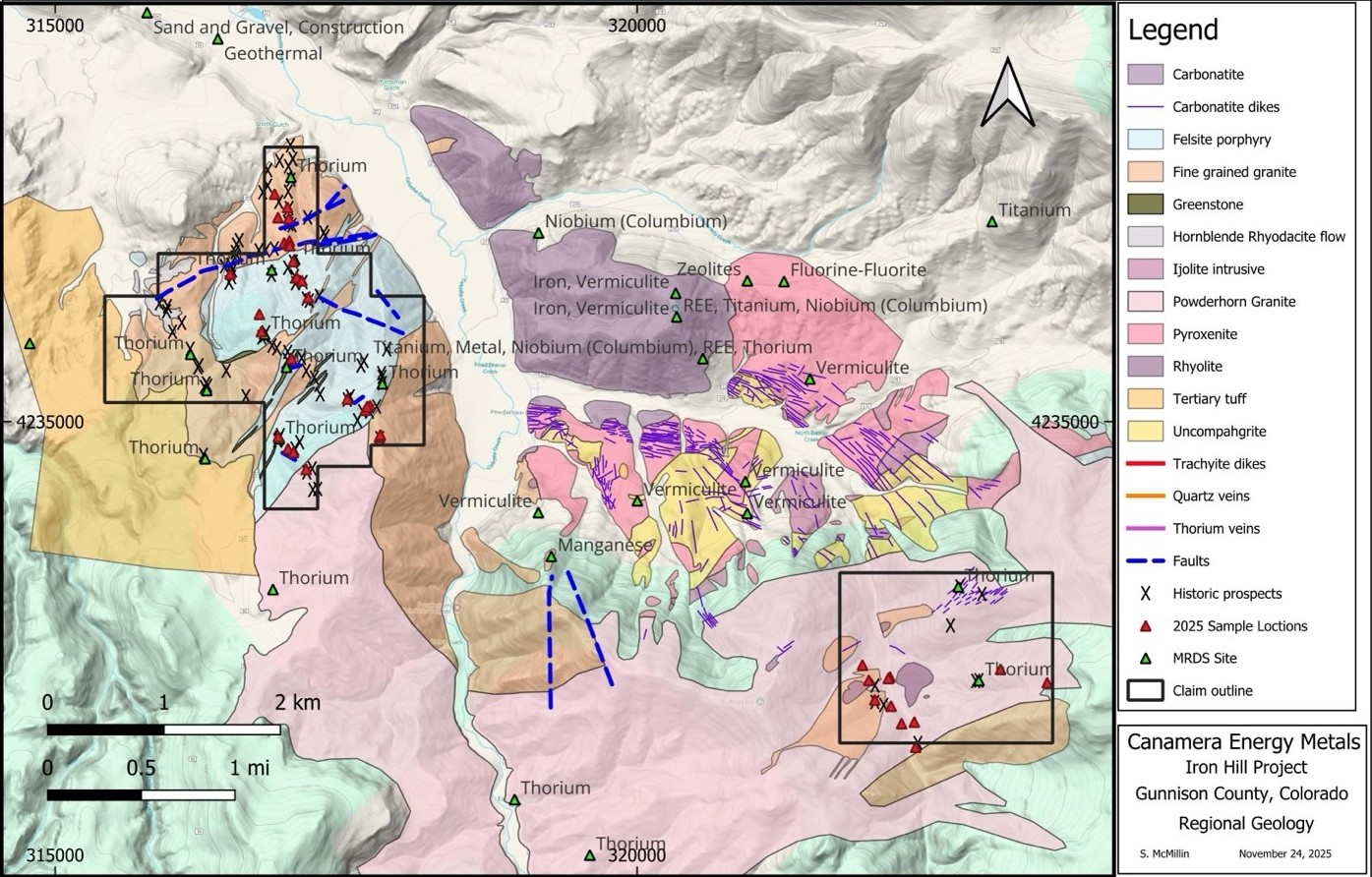
Iron Hills West: underlain by fine-grained granite and felsite porphyry intrusive rocks, hosts a number of documented thorium occurrences6 which are associated with trachyte (felsite) dikes and veins, both of which are associated with rare earth occurrences. Primary exploration targets would be the contact between the felsite porphyry and fine-grained granite (see map). Claims covering documented thorium occurrences at the contact between felsic porphyry and the fine-grained granite, represent areas for exploration follow up that is both independently significant and potentially genetically linked to the Iron Hill carbonatite system. This geological setting offers multiple vectoring mechanisms for REE-Th-U mineralization and represents a different—but complementary—exploration model to the carbonatite-alkaline targets.
Iron Hills East: Located on the east side of the alkalic complex and include both alkaline intrusive rocks and carbonatite dikes that extend from the main carbonatite mass to the northwest (Iron Hills Deposit). There is an abundance of historic prospect pits in this area in the vicinity of the carbonatite dikes. Primary exploration areas would be mapped carbonatite dikes radiating from, or associated with the intrusive mass that hosts the Iron Hills deposit (see map). The project lies along projected extensions of this radial dike system, offering targets for carbonatite dike-hosted REE-Nb mineralization. Carbonatite dikes elsewhere in the world (e.g., Mountain Pass, Bear Lodge) have proven to be economically significant.
Stay Informed
News and Updates